75 billion dollars. That's how much SpaceX raised in its IPO, making it the largest public market debut in history. And on its first day of trading on the Nasdaq, shares opened 11% above the IPO price. Elon Musk is now, officially, the world's first trillionaire.
Honestly, I had to read that twice.
I cover humanoids and embodied AI, so SpaceX isn't exactly my usual beat. But this story touches on something I think about a lot: what happens when the line between science fiction and investable reality gets blurry? And right now, that line is basically gone.
Much of SpaceX's growth forecast, as Bloomberg reported ahead of the debut, hinges on ideas that genuinely sound like they belong in a novel. Reusable rockets were supposed to be impossible. Starlink was supposed to be a money pit. Musk pulled both off, or at least pulled them off enough that the market believes the pattern holds.
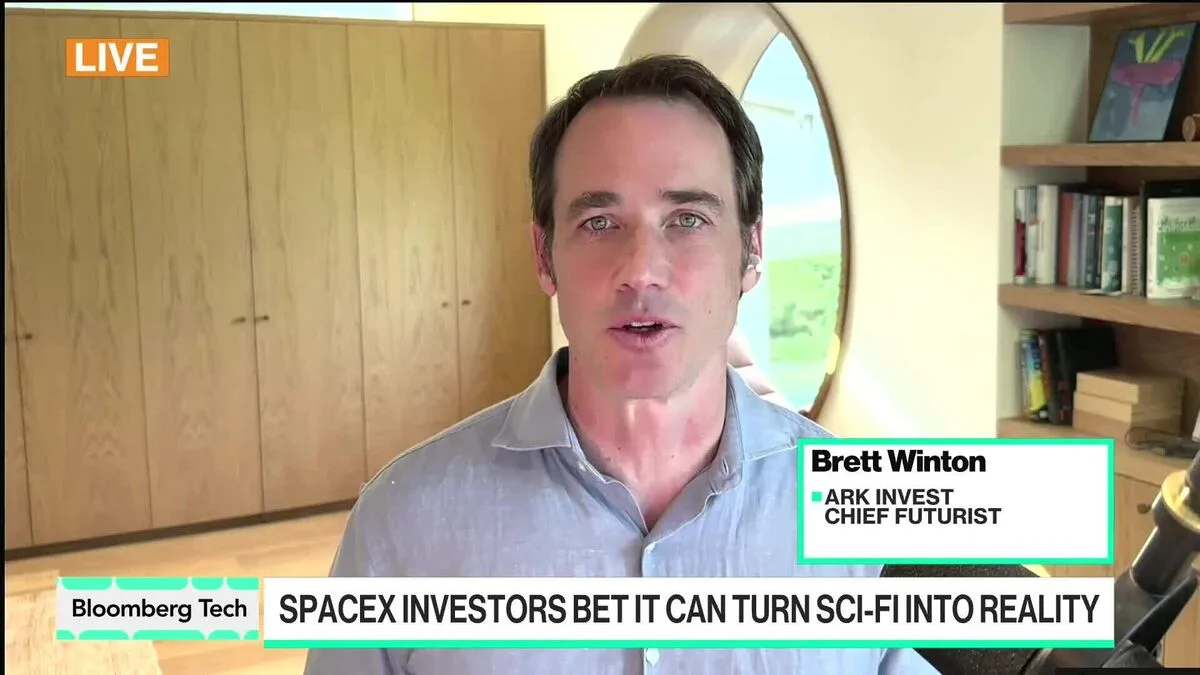
Brett Winton, chief futurist at ARK Invest and one of the more prominent institutional voices backing Musk's companies, appeared on "Bloomberg Tech." to make exactly that case. The argument is essentially: he's done the unbelievable before, so price in the unbelievable again.
I initially thought this was just classic momentum investing dressed up in futurist language. But after reading more about the specific bets embedded in SpaceX's valuation, I think it's more complicated than that. Some of this is genuinely hard to dismiss.
Here are the key things investors seem to be pricing in:
- Starlink's continued global expansion, particularly in underserved markets where terrestrial broadband isn't viable
- Point-to-point Earth travel via rocket, which remains more concept than product but keeps appearing in analyst notes
- Mars colonisation infrastructure, which is, tbh, still very much in the sci-fi column for most people
- Space farming and off-world habitation tech, a thread picked up by Interstellar Lab's Barbara Belvisi on Bloomberg's coverage, who discussed how space agriculture could support life on the Moon and Mars
- A potential Tesla merger, which analysts Max Chafkin and Ed Ludlow flagged as a live question now that SpaceX is public
That last one is worth sitting with. A Tesla-SpaceX merger would be one of the stranger corporate combinations in history. It's unclear whether that's actually on the table or just the kind of speculation that fills airtime on IPO day. We don't know yet, and anyone claiming certainty is probably getting ahead of themselves.
What the $75 billion number actually signals
You might be wondering why the IPO size matters beyond the obvious "it's a lot of money" observation. The reason it's significant is what it says about institutional appetite for long-horizon, high-variance bets right now.
SpaceX isn't profitable in the traditional sense. It's a company where the bull case requires believing that multiple currently-speculative revenue streams will materialise over a decade or more. And yet $75 billion walked in the door. That's not retail investors chasing hype. That's serious money making a serious bet.
The investor panel that joined Bloomberg Tech's coverage on June 12 included 137 Ventures Partner Christian Garrett, Pegasus Tech Ventures Founder Anis Uzzaman, Laffer Tengler Investments CEO Nancy Tengler, and Tesla retail investor Alexandra Merz. That's a pretty wide range of perspectives, from institutional venture to retail. The fact that the retail voice was a Tesla investor is interesting in itself. There's a loyal Musk-adjacent investor base that has now been given a new vehicle.
For the AI IPO pipeline specifically, this matters. If SpaceX can command this kind of valuation on speculative future revenues, it arguably gives cover to other deep-tech companies to go public sooner rather than later. Several analysts made this point in the Bloomberg Open Interest coverage. The logic: SpaceX sets a new benchmark for what public markets will accept.
Where I land on this, tentatively
I should be honest about the limits of what I can assess here. This is based on IPO-day coverage and analyst commentary, not a deep read of SpaceX's S-1 or their actual financials. That matters. IPO-day sentiment and long-run value are very different things, and the history of high-profile public debuts is littered with companies that opened strong and faded.
What I do think is genuinely interesting is the Mars farming angle. Interstellar Lab's work on closed-loop agricultural systems for space environments has implications that extend well beyond rockets. If you can grow food in a controlled environment on Mars, you've basically solved controlled environment agriculture for Earth too. That's a real technology with near-term terrestrial applications, and it's the kind of thing that tends to get buried under the headline numbers on a day like this.
The humanoid angle, since that's what I actually cover: it's worth noting that any serious Mars colonisation plan eventually runs into the question of what does the physical labour. Musk has been public about believing humanoid robots play a role in that future. Optimus exists. The connection between SpaceX's long-term ambitions and the humanoid robotics space isn't incidental. Whether the timeline for that is 10 years or 50 years is genuinely unclear, and I'd be sceptical of anyone who gives you a confident answer.
For now, SpaceX is public, Musk is a trillionaire, and the market has decided that science fiction is a reasonable basis for a $75 billion raise. What happens next is, in a way, the most interesting question in tech right now.