Image credit: Image via TechCrunch — AI. Used under fair use for news commentary. · source
Google's AI Overviews represent a genuine technical achievement in integrating large language models with search infrastructure. I want to be clear about that upfront, because what I'm about to describe might sound like I'm dismissing the whole project, and I'm not. But the "disregard" incident that unfolded this Friday reveals something important about the fundamental tension between what these systems are and what Google wants us to think they are.
Here's what happened: users discovered that searching for the word "disregard" on Google caused the AI Overview feature to respond with something like "Got it. If you need anything else or have a new question later, just let me know!" according to The Verge. Not a definition. Not search results. A chatbot acknowledgment, as if you'd just given it an instruction rather than a query. The system interpreted a search term as a command.
To be precise, what we're seeing here is a failure mode that exposes the underlying architecture. Google's AI Overviews aren't really a search feature with AI assistance. They're a large language model that's been prompted to behave like a search feature. And when you type a word that commonly appears in prompt injection attacks or system instruction contexts, the mask slips.
I should note that Google responded quickly. By Friday afternoon, searching "disregard" no longer produced an AI Overview at all. Instead, users saw news articles about the bug itself. This is the correct emergency response, but it's also an admission that the system couldn't be trusted to handle a common English word without potentially exposing its instruction-following nature.
Related coverage
More in AI Models
Chipmakers swung wildly this week, from a Tuesday 'chip-wreck' to a Micron-led surge after hours. What's actually going on with AI's hardware backbone?
Sarah Williams · 26 Jun · 5 min
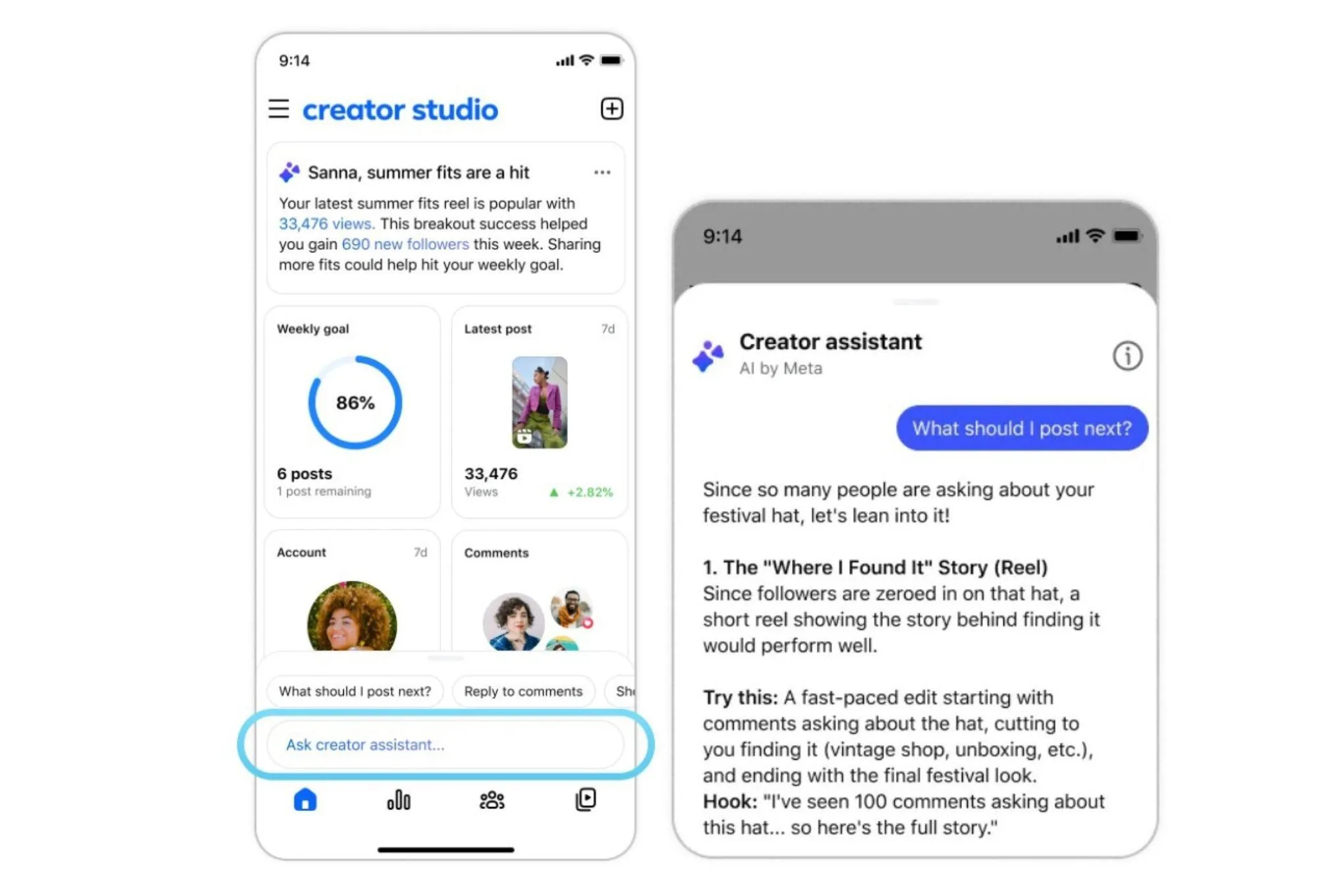
The original Creator Studio was shut down in 2023. Now it's back, rebuilt around an AI assistant that promises to grow your audience and reply to comments in your voice.
Sarah Williams · 26 Jun · 5 min
At its annual Config conference, Figma announced coding layers, AI-generated motion graphics, and a reimagined canvas that blurs the line between design and full-stack development.
Sarah Williams · 26 Jun · 5 min
Everyone talks about chips and models. The memory bottleneck is the part of the AI buildout that keeps getting underestimated, and Micron's latest earnings make that case hard to ignore.
The technical explanation here is actually fascinating if you're willing to get into the weeds (and I know I'm being picky here, but the details matter). Large language models are trained on enormous corpora that include not just natural text but also examples of human-AI conversations, system prompts, and instruction-following patterns. Words like "disregard," "ignore previous instructions," or "forget everything above" appear frequently in contexts where the model is being told to change its behavior. When these words appear in user input, there's a statistical association with instruction-following rather than information retrieval.
This isn't a bug in the traditional sense. It's an emergent property of how these models learn. The model didn't malfunction; it did exactly what its training suggested it should do when encountering that token in that context. The bug, if we want to call it that, is in the decision to deploy a system with this failure mode in a search interface used by billions of people.
What makes this particularly interesting from a research perspective is that prompt injection vulnerabilities have been extensively documented in the academic literature for at least two years now. The work coming out of ETH Zurich, the papers from Greshake et al. on indirect prompt injection, the demonstrations by security researchers at various conferences. None of this is new. Google's AI safety teams are certainly aware of these issues. The question is whether the pressure to ship AI features has outpaced the ability to robustly defend against known attack vectors.
I want to complicate my own argument here, because it's too easy to be dismissive. Defending against prompt injection in a search context is genuinely hard. You can't simply filter out words like "disregard" because those are legitimate search queries. Someone might want to know the definition of the word, or search for legal documents containing that term, or find articles about this very incident. The system needs to distinguish between "user is searching for information about this word" and "user is attempting to manipulate the model's behavior." That distinction requires understanding intent, which is, well, it's the hard problem.
The approaches that have been proposed in the literature (input sanitization, output filtering, instruction hierarchy, model fine-tuning for robustness) all have significant limitations. Input sanitization breaks legitimate queries. Output filtering can be bypassed with creative phrasing. Instruction hierarchy helps but doesn't eliminate the problem. Fine-tuning for robustness often degrades performance on normal queries. There's no clean solution here, and anyone who tells you otherwise is selling something.
But here's where I think the criticism is warranted: Google chose to deploy this feature at scale knowing these limitations exist. The company made a calculated decision that the benefits of AI Overviews (user engagement, competitive positioning against ChatGPT and Perplexity, the general AI hype cycle) outweighed the risks of public embarrassment when failure modes inevitably surfaced. That's a business decision, not a technical one, and it's worth being clear-eyed about that.
TechCrunch reported that the word "disregard" now "effectively breaks the search interface," which is a bit dramatic but captures the user experience. When a search engine can't reliably handle a dictionary word, something has gone wrong at a fundamental level. Not catastrophically wrong, not dangerously wrong, but wrong in a way that should make us question the maturity of this technology for this particular application.
The comparison to traditional search is instructive. If you typed "disregard" into Google five years ago, you'd get a definition, some usage examples, maybe some legal documents, news articles. The system would treat your query as what it obviously was: a request for information about a word. The new system, with its AI layer, introduced a failure mode that didn't previously exist. This is the tradeoff we're making, and it's worth asking whether the benefits justify the costs.
I've been following the research on LLM robustness for a while now, and the honest assessment is that we don't have good solutions to these problems yet. The papers that claim to "solve" prompt injection typically work in constrained settings that don't generalize to production systems. The security community has been playing whack-a-mole with new attack vectors, and the defenders are consistently behind. This isn't a criticism of the researchers; it's just the current state of the field.
What I'd want to see next is more transparency from Google about how they're thinking about these tradeoffs. The company has published some work on AI safety, but the specific decisions around AI Overviews deployment, the risk assessments, the failure mode analyses, remain opaque. We're left to infer their reasoning from their actions, which is not ideal for a feature that affects billions of searches daily.
Tom's Guide noted that Google has responded to the incident, though the details of that response weren't fully clear at the time of their reporting. The pattern we've seen with previous AI Overview failures (the glue on pizza incident, the eating rocks recommendation) is that Google patches the specific failure, issues a statement about continuous improvement, and moves on. This is reasonable crisis management but it doesn't address the underlying architectural issues.
There's a broader point here about the current moment in AI deployment. We're in a period where competitive pressure is pushing companies to ship features that aren't fully ready. Not unsafe necessarily, but not robust either. The "disregard" bug is embarrassing, not dangerous. Nobody was harmed. But it's a signal, a small crack that suggests larger structural issues beneath the surface.
The research community has been warning about this for years. Actually, the research shows that prompt injection is likely to remain a persistent challenge for LLM-based systems until we develop fundamentally different architectures or training approaches. The current paradigm of "train a model to follow instructions, then try to constrain which instructions it follows" has inherent tensions that can't be fully resolved with patches and filters.
I want to end with some uncertainty, because I think that's intellectually honest. It's too early to say whether AI Overviews will ultimately be remembered as a successful product that had some early stumbles, or as a cautionary tale about premature deployment. The technology is improving rapidly. The failure modes are being catalogued and addressed. Google has enormous resources and genuine technical talent working on these problems. It's possible that in two years, we'll look back at the "disregard" incident as a minor hiccup in an otherwise successful rollout.
But it's also possible that we'll look back at this period and wonder why we were so eager to replace systems that worked reliably with systems that failed in novel and unpredictable ways. The old Google Search had its problems, but it didn't interpret your query as a command and respond with chatbot pleasantries. There's something to be said for boring reliability.
The word "disregard" is back in Google's search results now, presumably with some special handling to prevent the AI Overview from misinterpreting it. But the underlying vulnerability hasn't been solved, just patched for this specific case. The next embarrassing failure is out there somewhere, waiting to be discovered by a curious user or a security researcher. That's the nature of these systems right now, and pretending otherwise doesn't serve anyone.