Google DeepMind Completes Gemini 2.5 Rollout with Cost-Focused Flash-Lite Model
The full Gemini 2.5 family is now stable and generally available, giving developers a spectrum of options from maximum capability to maximum efficiency.
Image credit: Image via Google DeepMind. Used under fair use for news commentary. · source
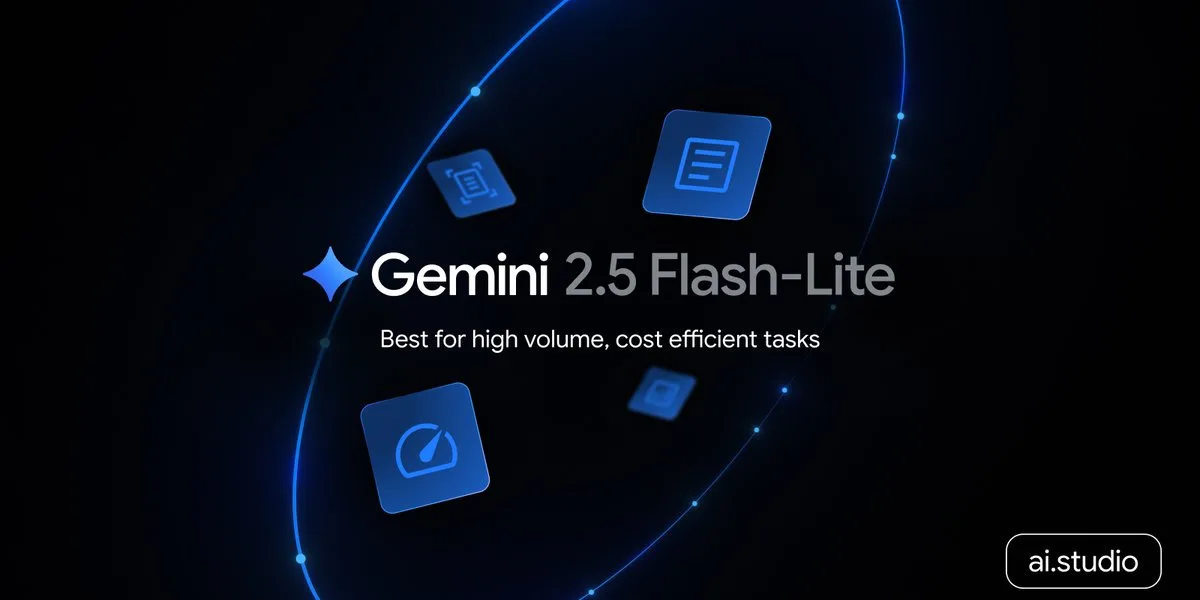
Google DeepMind has moved its entire Gemini 2.5 model family to general availability, completing a rollout that gives developers three distinct options for building AI-powered applications. The announcement marks the stable release of Gemini 2.5 Flash-Lite, the smallest and most cost-efficient model in the lineup.
What exactly is available now?
The Gemini 2.5 family now includes three production-ready models. Gemini 2.5 Pro sits at the top as the most capable option. Gemini 2.5 Flash offers a balance of performance and speed. And the newly stable Flash-Lite prioritizes cost efficiency above all else.
All three models share core capabilities that define the 2.5 generation. Each supports a 1 million-token context window, which means they can process roughly 750,000 words of text in a single request. All three also support multimodal inputs, handling text, images, and other data types together.
Why does Flash-Lite matter for robotics applications?
Think of the three models as different engines for different vehicles. Pro is the powerful option for complex reasoning tasks. Flash handles most workloads efficiently. Flash-Lite is designed for high-volume, cost-sensitive applications where you need to make many inference calls without breaking the budget.
Related coverage
More in AI Models
Chipmakers swung wildly this week, from a Tuesday 'chip-wreck' to a Micron-led surge after hours. What's actually going on with AI's hardware backbone?
Sarah Williams · 26 Jun · 5 min
The original Creator Studio was shut down in 2023. Now it's back, rebuilt around an AI assistant that promises to grow your audience and reply to comments in your voice.
Sarah Williams · 26 Jun · 5 min
At its annual Config conference, Figma announced coding layers, AI-generated motion graphics, and a reimagined canvas that blurs the line between design and full-stack development.
Sarah Williams · 26 Jun · 5 min
Everyone talks about chips and models. The memory bottleneck is the part of the AI buildout that keeps getting underestimated, and Micron's latest earnings make that case hard to ignore.