Broadcom's AI Chip Forecast Miss Reveals the Gap Between Hype Cycles and Hardware Realities
A $1.6 billion shortfall in projected AI chip revenue sounds small, but it tells us something important about where the semiconductor industry actually stands.
Image credit: Image via Source article. Used under fair use for news commentary. · source
Think of semiconductor forecasting like weather prediction. Everyone knows roughly what season we are in, and the general direction of temperatures, but the difference between a forecast of 72 degrees and an actual reading of 70 degrees can determine whether your outdoor wedding goes smoothly or guests start complaining. Broadcom just delivered the investor equivalent of that two-degree miss, and the market response tells us something important about how tightly wound expectations have become in the AI chip space.
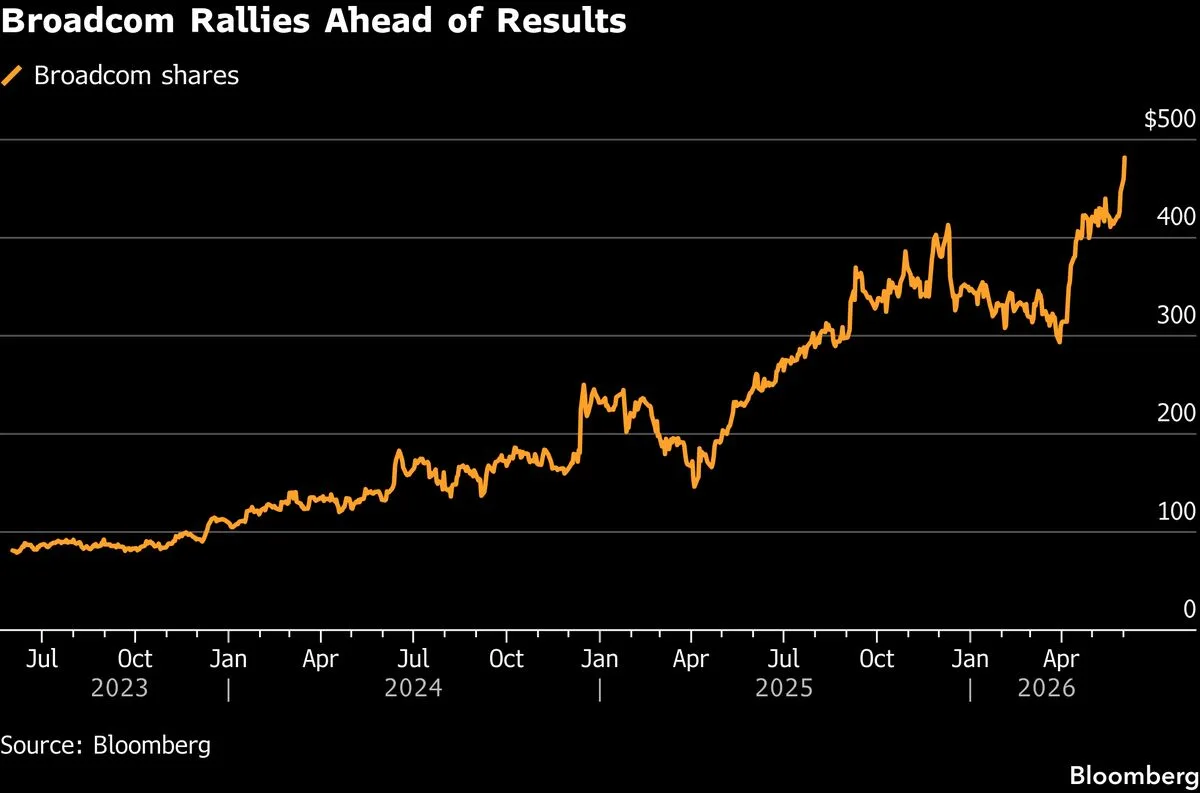
Broadcom's shares fell sharply in extended trading after the company projected $56 billion in AI chip revenue for the fiscal year ending in October 2026. The average analyst estimate had been $57.6 billion. That is a difference of $1.6 billion, or roughly 2.8 percent. In most industries, coming within three percent of analyst expectations would be considered a solid performance. In the current AI semiconductor environment, it triggered what Bloomberg described as the company's biggest single-day drop since January 2025. The context here matters: Broadcom had added more than $280 billion in market value over just four trading sessions leading into the earnings report, according to Bloomberg's coverage of the pre-earnings rally. That kind of run-up creates its own gravitational field of expectations.
I want to be precise about what this actually tells us, because the headline framing of "disappointing outlook" obscures some nuance. Broadcom is not struggling. The company is projecting $56 billion in AI chip revenue, which by any historical standard represents extraordinary growth. The disappointment is relative to a very specific set of analyst models that had baked in even faster acceleration. This is not a story about AI demand collapsing. It is a story about the gap between exponential expectation curves and the messier reality of semiconductor manufacturing, customer deployment timelines, and supply chain constraints.
Related coverage
More in AI Models
Chipmakers swung wildly this week, from a Tuesday 'chip-wreck' to a Micron-led surge after hours. What's actually going on with AI's hardware backbone?
Sarah Williams · 26 Jun · 5 min
The original Creator Studio was shut down in 2023. Now it's back, rebuilt around an AI assistant that promises to grow your audience and reply to comments in your voice.
Sarah Williams · 26 Jun · 5 min
At its annual Config conference, Figma announced coding layers, AI-generated motion graphics, and a reimagined canvas that blurs the line between design and full-stack development.
Sarah Williams · 26 Jun · 5 min
Everyone talks about chips and models. The memory bottleneck is the part of the AI buildout that keeps getting underestimated, and Micron's latest earnings make that case hard to ignore.
To understand why this matters for robotics specifically, we need to think about what Broadcom actually makes. The company is not primarily known for the kind of edge inference chips that go into robots directly. Their AI business centers on custom accelerators and networking components for hyperscale data centers. But here is the connection that matters: the same foundational infrastructure that trains large models and runs cloud-based inference also underpins the increasingly common architecture where robots offload heavy computation to remote servers. When Broadcom's CEO Hock Tan talks about AI chip demand, he is talking about the backbone that many robotics companies are building their products on top of.
The research literature on cloud-connected robotics has been growing substantially over the past three years. Papers from groups at Berkeley, Stanford, and CMU have demonstrated architectures where robots maintain only lightweight local inference capabilities while streaming sensor data to cloud endpoints for heavy model inference. This approach makes economic sense for many applications, particularly in controlled environments like warehouses or manufacturing floors with reliable connectivity. But it also means that the pace of robotic AI deployment is partially coupled to the pace of data center infrastructure buildout. If Broadcom is seeing slower-than-expected growth in AI chip deployments, that could indicate either supply constraints or, more interestingly, that customers are taking longer to actually deploy and utilize the infrastructure they have already purchased.
Actually, the research shows something important here that often gets lost in earnings coverage. There is typically a lag of 12 to 24 months between when hyperscalers purchase AI accelerator infrastructure and when that infrastructure reaches full utilization. Companies buy ahead of demand, both because lead times are long and because they are competing with each other for limited supply. This means that current chip sales reflect expectations about future demand, and a slight miss on forecasts could indicate that those expectations are being revised even marginally downward. It is worth noting that we do not have great visibility into actual utilization rates at major cloud providers. They do not publish this data, and the estimates that circulate in analyst reports vary widely.
I know I am being picky here, but the framing of this as an "AI chip outlook disappointment" conflates several distinct phenomena. There is the question of total AI chip demand, which by all available evidence remains extremely strong. There is the question of Broadcom's specific competitive position against Nvidia and AMD in the AI accelerator market. There is the question of whether custom silicon programs for hyperscalers are ramping as quickly as expected. And there is the question of whether the networking and interconnect business, which is essential for scaling AI clusters, is tracking projections. The earnings miss could reflect softness in any or all of these areas, and the company's public statements do not provide enough granularity to distinguish between them.
For robotics researchers and practitioners, the relevant signal here is probably not about Broadcom specifically but about the broader infrastructure trajectory. The implicit assumption in much of the current robotics AI research is that compute will continue to get cheaper and more available at a rapid pace. Foundation models for robotics, whether we are talking about RT-2 derivatives, behavior cloning approaches, or the various world model architectures being explored, all assume access to substantial training compute and, increasingly, inference compute at the edge or in the cloud. If the infrastructure buildout is proceeding more slowly than the most optimistic projections suggested, that could affect timelines for when these approaches become economically viable at scale.
This brings me to a methodological concern I have with how the tech press covers semiconductor earnings. The sample size of data points is inherently small. We get quarterly reports from a handful of major companies, and we try to extrapolate from those to the state of an entire industry. But the variance between companies is enormous, and idiosyncratic factors (a single large customer delaying an order, a yield issue at a fab, a change in inventory policy) can easily swing results by a few percentage points. When Broadcom misses estimates by 2.8 percent, that is within the noise band of normal business variation. The market reaction, with billions of dollars in value evaporating, reflects the extreme sensitivity of current valuations to any deviation from the expected trajectory.
There is a parallel here to how robotics startups get evaluated. I have watched companies see their perceived value swing dramatically based on a single demo video or a minor product delay. The underlying technology and team remain the same, but narrative momentum creates these feedback loops where small signals get amplified. Broadcom's earnings miss is not, to be precise, evidence that AI demand is weakening or that the semiconductor industry is in trouble. It is evidence that expectations had gotten ahead of reality by a small margin, and that the current market structure punishes even small misses severely.
What would I want to see to actually understand what is happening in AI infrastructure deployment? First, utilization data from cloud providers, which they will never voluntarily share. Second, more granular breakdowns of AI chip revenue by end application, distinguishing between training, inference, and networking. Third, longer time series data on the gap between chip shipments and actual deployment. We have none of these things, so we are left inferring from quarterly revenue figures that aggregate across too many distinct phenomena to be truly informative.
The robotics implications remain unclear, and I want to be honest about that uncertainty. If this earnings miss reflects a genuine slowdown in AI infrastructure buildout, that could delay the timeline for when cloud-based robotics architectures become cost-effective for a broader range of applications. If it reflects nothing more than quarterly noise and analyst model errors, then it tells us very little about the underlying trajectory. The honest answer is that we do not have enough information to distinguish between these scenarios. What we can say is that the AI chip market remains in a phase where expectations are extremely elevated and any deviation from perfection triggers significant repricing.
For researchers working on robotics AI, the practical takeaway is probably to maintain some skepticism about projections that assume unlimited cheap compute availability on aggressive timelines. The infrastructure will continue to build out, but the pace may be more uneven than the most optimistic scenarios suggest. Companies building products that depend on cloud inference should think carefully about latency requirements, connectivity assumptions, and the cost structure of their compute dependencies. The future where every robot has access to foundation model inference at negligible cost is coming, but the path there may have more bumps than the hype cycle would suggest.
I should note that this analysis is based on limited data. We have Broadcom's top-line guidance, analyst estimates, and stock price movements. We do not have detailed breakdowns of where the shortfall came from or what specific customer segments drove the miss. The company's actual earnings call likely contained more detail, but the publicly available coverage focuses on the headline numbers. This is a limitation of trying to draw conclusions from earnings reports in real time, and I would want to see the full transcript and analyst Q&A before making stronger claims about what this means for AI infrastructure trajectories.
The broader pattern here is familiar to anyone who has watched technology cycles unfold. Expectations run ahead of reality, prices adjust, and then the actual technology continues to develop on its own timeline regardless of what the stock market thinks. Broadcom will ship roughly $56 billion in AI chips this fiscal year, which is an enormous number by any historical standard. The fact that this is framed as a disappointment tells us more about the current state of market psychology than about the underlying technology trajectory. For robotics, the relevant question is not whether Broadcom beat or missed estimates, but whether the infrastructure needed to support advanced robotic AI is being built at a pace that matches the research community's ambitions. The answer to that question remains genuinely uncertain, and anyone who claims to know with confidence is probably overconfident.