Remember when every enterprise software company in 2007 suddenly became a "cloud company"? Didn't matter what they actually did. Slap the word cloud on it, raise a round, watch the valuation climb. I watched that happen from a press row at a conference in San Francisco and thought, well, here we go again. That feeling came back hard this week.
Two stories landed within days of each other, and taken separately they're just funding news. Taken together, they're a pretty clear signal about where the AI infrastructure arms race is actually going, and who's positioning to win it.
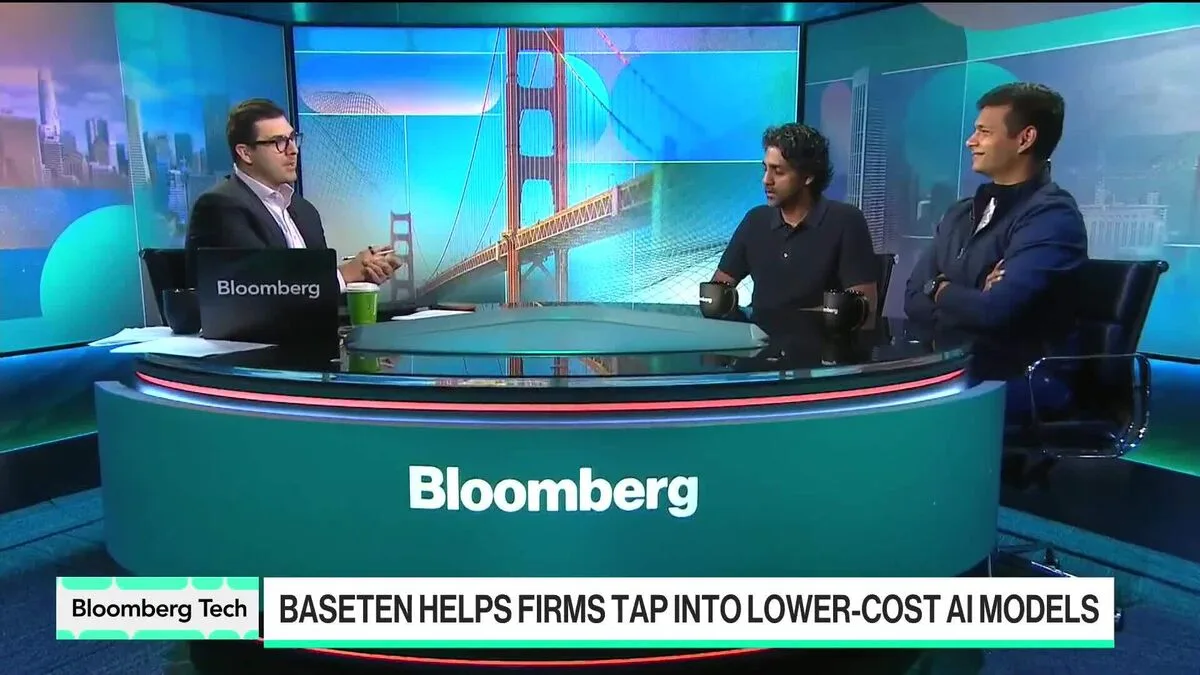
First, Baseten. The company, which provides software and computing capacity to businesses that want to tap into lower-cost AI models, just closed a $1.5 billion Series F round at a $13 billion valuation. That's according to Bloomberg, which sat down with Baseten CEO Tuhin Srivastava and Apoorv Agrawal, the Altimeter partner who co-led the round.
Thirteen billion dollars. For a company most people outside of ML engineering circles had never heard of six months ago.
Now, I'll be honest: I had to look up exactly what Baseten does, because the pitch is genuinely a bit abstract if you're not deep in the inference stack. The short version is that they sit between enterprises and the increasingly crowded market of cheaper, open-weight AI models. Companies don't want to pay OpenAI prices for every API call. Baseten helps them not do that, while handling the compute and deployment headaches underneath.
That's a real problem. And it's a growing one. As models from Mistral, Meta, and a dozen other outfits get genuinely competitive with GPT-4-class performance at a fraction of the cost, the bottleneck shifts from "which model" to "how do I actually run this thing reliably at scale." Baseten's answer is: let us handle it.
Whether a $13 billion valuation is justified for that answer is, frankly, unclear to me. I only found limited public detail on revenue figures or customer count in what's been reported so far, so I'm not going to pretend I can reverse-engineer the multiple. What I can say is that Altimeter doesn't usually lead rounds this size on vibes alone, and Agrawal's involvement suggests at least some institutional conviction here that goes beyond hype.
But I've seen this movie before. Infrastructure plays in a hot cycle always look like obvious bets until the cycle turns and you realize three other companies built the exact same pick-and-shovel.
Which brings me to the second story, and honestly the one that I think has longer legs.
OpenAI unveiled its first custom AI chip this week, called Jalapeno, developed in partnership with Broadcom. Bloomberg covered the announcement alongside news that SK Hynix is planning a $29 billion US listing, and Cerebras CEO Andrew Feldman weighing in on his company's first quarterly earnings since going public.
Let's park SK Hynix for a second and focus on Jalapeno, because this is the kind of move that looks incremental and is actually enormous.
OpenAI has been, since its founding, almost entirely dependent on Nvidia for compute. Everyone has. That's not a secret. It's also not sustainable if you're trying to run the largest AI inference operation on the planet and Nvidia gets to set the price. So OpenAI does what every platform company eventually does when a supplier gets too powerful: it starts building its own hardware.
Google did this with TPUs. Amazon did this with Trainium and Inferentia. Apple did this with the M-series chips. The pattern is old and it's consistent, and it always takes longer than the company announces and costs more than they admit publicly. But it always happens.
Jalapeno, developed with Broadcom rather than built entirely in-house, is a pragmatic first step. Broadcom has the chip design expertise and the manufacturing relationships. OpenAI has the workloads and the cash. It's not a clean break from Nvidia, not yet, but it's the beginning of one. It's too early to say how competitive Jalapeno will actually be against H100s or whatever Nvidia ships next, but the intent here is clear.
Here's what I keep coming back to. Baseten raises $1.5 billion to help enterprises run cheaper, third-party models. OpenAI builds custom silicon to reduce its own infrastructure costs. Both moves are pointing at the same underlying pressure: the economics of AI at scale are brutal, and everyone in the stack is trying to find margin somewhere.
For Baseten, the margin opportunity is in being the managed layer between enterprises and a fragmented model market. For OpenAI, it's in owning more of the hardware stack so Nvidia doesn't eat all the profit from inference growth. For SK Hynix, raising $29 billion in the US, it's in being the memory supplier that nobody can do without when AI chips need HBM bandwidth.
This is infrastructure buildout. Full stop. And infrastructure buildouts follow a pretty reliable pattern: massive capital inflows, a period of genuine consolidation, a shakeout where half the players disappear, and then a stable oligopoly that prints money for twenty years. We did this with telecom in the 90s. We did it with cloud in the 2010s. We're doing it again.
The question isn't whether AI infrastructure is a real business. It obviously is. The question is which of these companies is still standing in 2030 and which ones got acqui-hired or quietly wound down.
I'd be leaving something out if I didn't mention Feldman and Cerebras, even briefly. The company went public and now has to report quarterly, which is its own kind of discipline. Feldman has been one of the more credible voices in the AI chip space for a while, and his first earnings call as a public company CEO will tell us something about whether the independent AI chip story can actually work against Nvidia's gravitational pull.
Cerebras is a different bet than Jalapeno. OpenAI is building custom silicon for its own workloads. Cerebras is trying to be a merchant chip vendor competing in the open market. Those are very different businesses with very different risk profiles. It remains unclear, at least to me, whether there's room for more than one or two non-Nvidia winners in merchant AI silicon. The history of custom chip companies trying to crack that market is not exactly encouraging.
But call me old-fashioned, I've been wrong about hardware companies before. Sometimes the scrappy one with a genuinely different architecture finds its lane.
If you're covering autonomous systems, robotics, or anything that runs inference at the edge, this week's news matters more than it might look. The cost of running AI models is going to drop, significantly, over the next three years. It has to. The current pricing isn't sustainable for the use cases that actually need to scale, and the infrastructure investment happening right now, from Baseten's managed inference layer to OpenAI's custom silicon to SK Hynix's memory capacity, is the market's answer to that pressure.
Cheaper inference means more deployment. More deployment means more robots, more autonomous vehicles, more edge AI in places we haven't thought of yet. The hardware and infrastructure layer is unglamorous compared to foundation models, but it's where the real enabling work happens.
I've been watching tech infrastructure cycles since the late 90s. The companies that win aren't always the flashiest ones. Sometimes they're just the ones that figured out the economics first.
Baseten might be one of those. Or it might be a $13 billion lesson in timing. We genuinely don't know yet.