Image credit: Image via Source article. Used under fair use for news commentary. · source
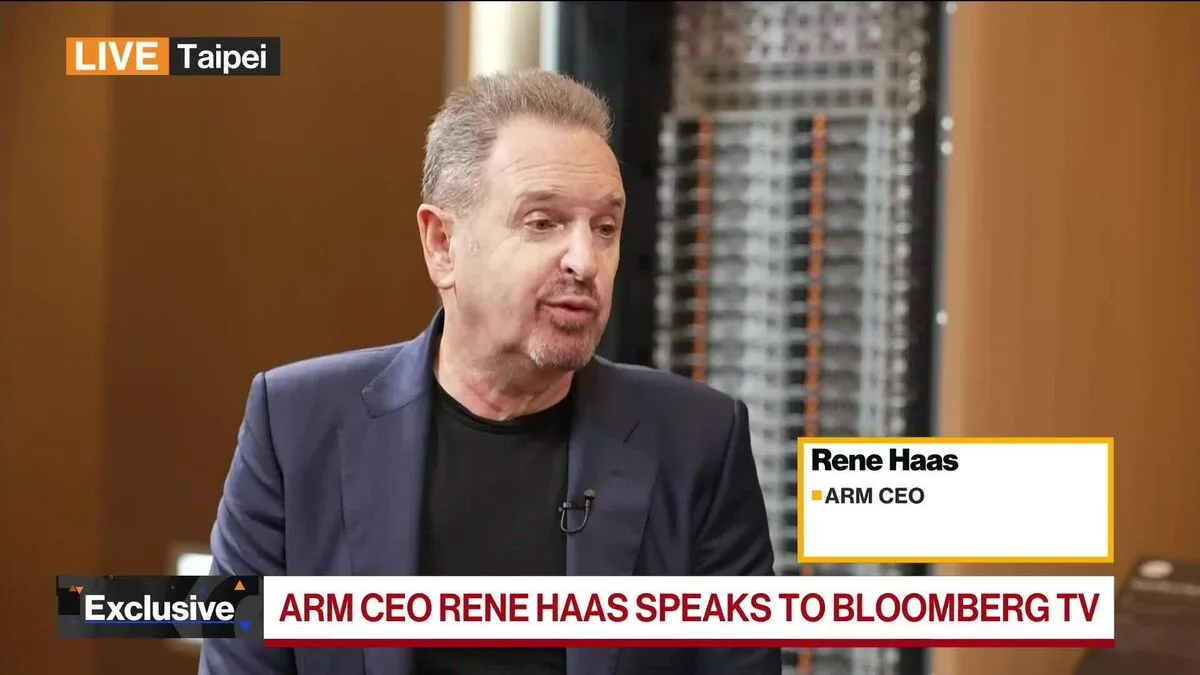
Think of Arm's business model like a toll road running through the entire semiconductor industry. The company doesn't manufacture chips; it licenses the architectural blueprints that other companies use to build them. When Arm's CEO Rene Haas announced at Computex this week that the company might reach its $15 billion chip revenue target ahead of schedule, he was essentially saying that traffic on that toll road is heavier than anyone predicted.
To be precise, we need to distinguish between two revenue streams here. Arm makes money from licensing its instruction set architecture (the fundamental rules that govern how processors execute code) and from royalties on chips that use its designs. The $15 billion figure Haas referenced appears to relate specifically to Arm's own-branded chips, which represents a relatively newer and more direct play in the hardware market. This is not the same as Arm's total revenue, and conflating the two would misrepresent the announcement.
The timing of this statement matters. Haas made these comments on the sidelines of Computex in Taipei, the annual trade show where semiconductor companies traditionally unveil their roadmaps and, not coincidentally, where competitive positioning statements carry extra weight. Bloomberg reported the comments, though the coverage was light on specifics about methodology or timeline.
What does "earlier than anticipated" actually mean? We don't know. The original timeline for the $15 billion target wasn't disclosed in the available reporting, which makes it difficult to assess how significant this acceleration really is. Hitting a five-year goal in four years is different from hitting a ten-year goal in nine. Without that baseline, the announcement functions more as a sentiment indicator than a quantifiable claim.
Related coverage
More in AI Models
Chipmakers swung wildly this week, from a Tuesday 'chip-wreck' to a Micron-led surge after hours. What's actually going on with AI's hardware backbone?
Sarah Williams · 26 Jun · 5 min
The original Creator Studio was shut down in 2023. Now it's back, rebuilt around an AI assistant that promises to grow your audience and reply to comments in your voice.
Sarah Williams · 26 Jun · 5 min
At its annual Config conference, Figma announced coding layers, AI-generated motion graphics, and a reimagined canvas that blurs the line between design and full-stack development.
Sarah Williams · 26 Jun · 5 min
Everyone talks about chips and models. The memory bottleneck is the part of the AI buildout that keeps getting underestimated, and Micron's latest earnings make that case hard to ignore.
The underlying driver, according to Haas, is stronger-than-projected demand from what he characterized as the AI boom. This framing is worth examining. Arm's architecture has historically dominated mobile computing (virtually every smartphone processor uses Arm designs) but has been making aggressive moves into data center and AI inference workloads. The company's Neoverse platform targets servers and cloud infrastructure, while its Ethos NPU designs are aimed at edge AI applications. If AI demand is pulling Arm's own-chip revenue forward, it suggests that at least some portion of that demand is flowing through Arm's more direct hardware business rather than just through licensing to partners like Nvidia, Apple, or Qualcomm.
It's worth noting that this creates an interesting tension. Arm's traditional customers are also its competitors in certain segments. When Arm sells its own chips, it's competing with the very companies that pay it licensing fees. The fact that this business is apparently growing faster than expected could indicate either that Arm has found niches its licensees aren't serving, or that the overall market is expanding fast enough that cannibalization concerns are secondary. Probably both, though the company didn't disclose figures that would let us determine the balance.
I know I'm being picky here, but the phrase "AI boom" deserves some scrutiny. The semiconductor industry has been through several cycles of AI-driven demand surges, and not all of them sustained. The current wave, driven primarily by large language models and generative AI, has produced genuinely unprecedented demand for training compute. But Arm's strength is more in inference (running trained models) than training (building them). The inference market is growing, certainly, but it follows different dynamics than the training market that's been grabbing headlines. Whether Arm's acceleration reflects sustainable inference demand or a more speculative buildout remains unclear.
The Computex context adds another layer. Taiwan is the center of global semiconductor manufacturing, and statements made there carry implicit messages to the supply chain. Haas's comments could be read as signaling to manufacturing partners (primarily TSMC, which fabricates most advanced Arm-based chips) that Arm expects to need significant capacity. They could also be aimed at investors, given that Arm went public in late 2023 and has been working to justify its valuation against a complex competitive landscape.
What would I want to see to evaluate this claim properly? First, the original timeline for the $15 billion target. Second, a breakdown of revenue by segment (licensing versus own-chip sales versus royalties). Third, some indication of which end markets are driving the acceleration. Is it data center? Edge AI? Automotive? The AI hardware market is not monolithic, and different segments have very different growth trajectories and competitive dynamics. Without this granularity, the announcement tells us that Arm's management is optimistic but doesn't give us the tools to assess whether that optimism is well-founded.
There's a broader question here about what Arm's trajectory tells us about the AI hardware landscape. The company occupies an unusual position: it's both an infrastructure provider (through licensing) and increasingly a direct competitor (through its own chips). If Arm is seeing accelerated demand, it could indicate that the AI hardware market is diversifying beyond the Nvidia-dominated training cluster paradigm toward a more heterogeneous mix of inference solutions. That would be consistent with what we're seeing in robotics, where edge inference requirements are driving interest in power-efficient architectures that Arm has traditionally excelled at.
Actually, the research shows that inference workloads in robotics and embodied AI systems have very different requirements than cloud-based inference. Latency constraints, power budgets, and reliability requirements in physical systems favor architectures that can run efficiently on constrained hardware. Arm's historical strength in mobile and embedded systems positions it well for this market, though competition from RISC-V and specialized AI accelerators is intensifying.
The sample size here is essentially one company's forward-looking statement at a trade show. This hasn't been validated by quarterly earnings, third-party analysis, or competitive benchmarking. It's useful as a data point about industry sentiment, but treating it as definitive evidence of market acceleration would be premature.
What seems reasonably clear is that Arm's management believes the AI-driven demand cycle has legs, at least for their business. What remains unclear is the magnitude of the acceleration, the sustainability of the underlying demand, and whether Arm's own-chip business can scale without damaging its licensing relationships. These are the questions that matter for understanding where AI hardware is heading, and they're precisely the questions that a Computex announcement doesn't answer.
The honest assessment is that we're watching a company signal confidence during a period of intense industry optimism. Whether that confidence is justified will become apparent in earnings reports over the next several quarters. For now, the announcement tells us more about Arm's strategic ambitions than about the underlying market dynamics. That's not nothing, but it's less than the headline might suggest.